Your First Solo Flight: What to Expect and How to Prepare
Published by:
Joe Vasquez
The right seat is empty. Your instructor just stepped out, closed the door, and gave you a nod. Now it is your hand on the throttle, your voice on the tower frequency, and your decision on every landing. For most student pilots, that moment is the one they remember longest.
If your first solo is coming up, you probably feel two things at once: excitement and a knot in your stomach. Both are normal. The good news is that solo day is built on a long list of specific skills, a knowledge test, and endorsements your instructor has already worked through with you. When the time comes, you are not guessing. You are demonstrating what you have practiced. Here at Universal Flight Training, we train at Sarasota Bradenton International Airport (SRQ), and this guide walks through the requirements, what the day usually looks like, and how to prepare so you walk to the airplane ready.
Check the paperwork before you think about the pattern
Solo flight has a clear regulatory foundation. The FAA’s rules for student pilot solo requirements live in 14 CFR 61.87, and knowing them removes a lot of mystery from the process.
| Requirement | What it involves | How this supports your next step |
|---|---|---|
| Student pilot certificate | You can take lessons without one, but you need it in hand before you fly solo. For airplanes, you must be at least 16 and able to read, speak, write, and understand English. | Apply early so paperwork never delays a solo-ready day. |
| Medical certificate | Most first-time airplane students need at least a third-class medical before solo. | Handle it early so there are no surprises late in training. |
| Pre-solo knowledge test | Your instructor gives the test and reviews every missed question with you. | It confirms you understand the rules, airspace, and airplane you will fly. |
| Pre-solo flight training | Logged training on specific maneuvers and procedures, flown to your instructor’s standard of proficiency and safety. | The skills you will rely on alone are already practiced and documented. |
| Solo endorsement | A logbook endorsement for the specific make and model, from an instructor who trained you within the preceding 90 days. | It keeps your solo privileges current as training continues. |
The student pilot certificate is an application your instructor can help you submit through the FAA’s IACRA system. The FAA’s student pilot certificate guidance explains that you do not need it for dual lessons, only before solo. Starting the application early in your Private Pilot Course keeps it from becoming the last item on your list.
On the medical side, the FAA expects most airplane students to hold a third-class medical certificate before a first solo. A narrow exception exists for pilots who meet the driver’s-license conditions tied to BasicMed, which generally requires having held an FAA medical certificate in the past. For a clear breakdown of classes and when BasicMed applies, see our guide to FAA medical certificate classes and BasicMed. If you have a medical history question, an Aviation Medical Examiner is the right person to answer it.
The 90-day solo endorsement surprises some students. Your endorsement is tied to the make and model you will fly, and an authorized instructor has to refresh it every 90 days to keep it current. As a student pilot, you also cannot carry passengers, and you have to follow any limitations your instructor writes in your logbook, such as wind limits.
Your instructor has already tested the skills solo asks for
Before your instructor signs you off, the FAA requires logged pre-solo training on a specific list of maneuvers. For single-engine airplanes, that list includes preflight preparation, taxiing and run-ups, normal and crosswind takeoffs and landings, traffic patterns, stalls and slow flight, emergency procedures, approaches with a simulated engine malfunction, slips to a landing, and go-arounds.
Your instructor is also judging something harder to put on a list: how you respond when the plan changes. A student who calmly calls a go-around after a bad approach, catches an incorrect radio readback, or handles a simulated engine failure without freezing is showing solo readiness. A student who lands well only when everything goes smoothly is still building it.
The pre-solo knowledge test is the ground side of that same picture. It covers applicable rules in Parts 61 and 91, the airspace and procedures at the airport where you will solo, and the flight characteristics and limitations of your airplane. Your instructor reviews every incorrect answer with you before authorizing solo. Our guide on what to expect on your FAA written exam is a good next read if you want to get ahead on the bigger knowledge test that comes later.
Solo timing comes from proficiency and your instructor’s judgment, students solo at different points because cadence, weather, prior experience, and learning style all shape progress. Consistent training helps, and our article on how many flight lessons per week to schedule explains why.
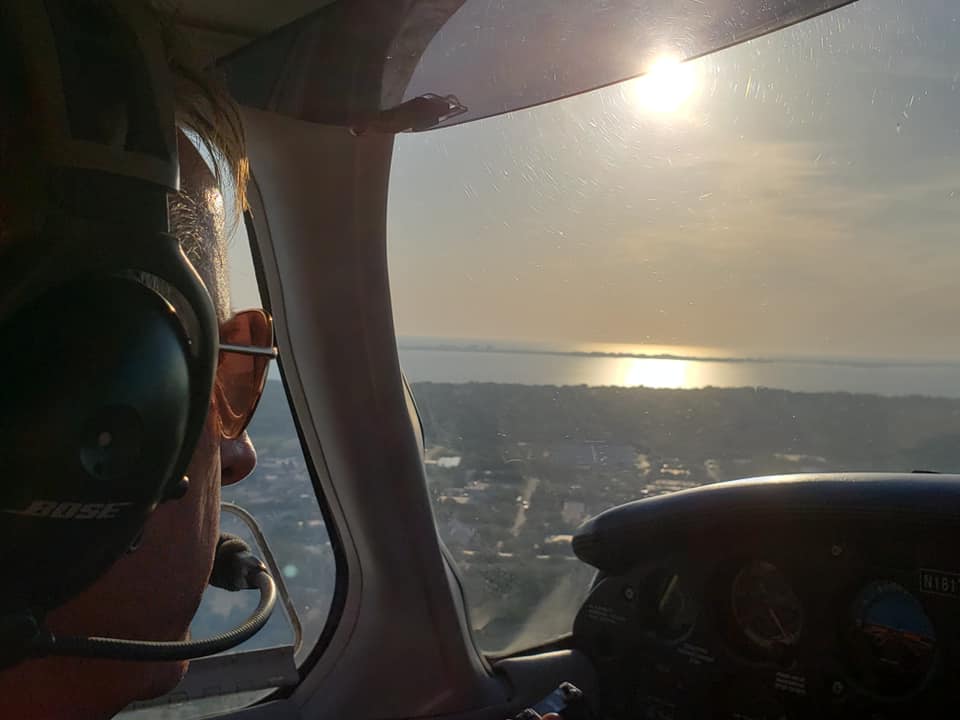
Solo flight is a proficiency milestone your instructor signs off on after documented training.
Solo day usually starts with your instructor still in the right seat
Many first solos follow a familiar shape, though your instructor sets the exact plan. You typically fly a few trips around the traffic pattern together first. Your instructor watches your landings, your radio calls, and your decision-making one more time. If everything looks solid and conditions are good, you land, your instructor completes the endorsement, and they step out of the airplane.
Then it is you. A first solo is often a short session of a few takeoffs and landings in the pattern, with your instructor watching from the ground. The flying itself is familiar. You have flown this pattern many times. The difference is the silence in the right seat and the knowledge that every decision is yours.
Solo day can also be postponed, and that is part of good training. Gusty winds, a building thunderstorm, or a rough session can all push it to another day.
Talking to SRQ Tower on your own is a skill you have already built
We train at a towered airport in Class C airspace, so your first solo includes real conversations with air traffic control. For many students, that is the part that feels biggest. It helps to remember that you have been making these calls with your instructor for weeks, and the tower is there to sequence traffic safely.
The FAA’s Aeronautical Information Manual recommends that student pilots identify themselves as “student pilot” on initial contact with ground, tower, and approach facilities. That short phrase lets controllers know to give you extra consideration if you need it. Use it.
Training at a busy airport also builds habits that carry forward. The private pilot requirements include solo takeoffs and landings at an airport with an operating control tower, so SRQ gives you that experience naturally. Our article on why Sarasota-Bradenton is a great place to learn to fly goes deeper on the local training environment.
Nerves are normal, and they point you toward preparation
Almost every student pilot feels nervous before a first solo. That feeling usually means you understand the responsibility. The goal is to channel it into preparation so the nerves stay in the background once the engine starts.
Here is how to prepare in the weeks before solo:
- Pattern consistency
Aim for stable approaches on every landing. Consistent altitude, airspeed, and pattern spacing make the landing itself easier. - Go-arounds without hesitation
Practice deciding early. A go-around is a normal, professional choice, and your instructor wants to see you make it without second-guessing. - Radio flow
Rehearse your calls on the ground. Knowing what you will say to ground and tower frees up attention for flying. - Emergency procedures
Review engine-failure, fire, and electrical checklists for your airplane until the flow feels automatic. - Personal readiness
Run the IMSAFE and PAVE checks before the flight. Our guide to IMSAFE and PAVE checklists explains both.
On the day itself, arrive rested and early. Give yourself time for a calm preflight, a snack, and a quick review of your checklists. If IMSAFE flags fatigue, stress, or illness, tell your instructor. Rescheduling a solo is a sign of good judgment, and the airplane will still be there next week.
Many students also find that the airplane feels livelier with one person aboard. With less weight, it may climb a little faster and float a little longer in the flare. Your instructor will usually brief you on this before stepping out.
The shirttail tradition marks a milestone you earned
A first solo has celebrated traditions at many flight schools. The best known is cutting the student’s shirttail after the flight. The story often told traces it to early training airplanes, when the instructor sat behind the student and tugged on a shirt to get attention. After a solo, you no longer need the tug.
Many schools decorate the cut shirttail with the date, the airplane, and the airport, then display it on the wall for the next students to see. Whatever the celebration looks like, the real reward is in your logbook: your first entry as the sole occupant of the airplane.
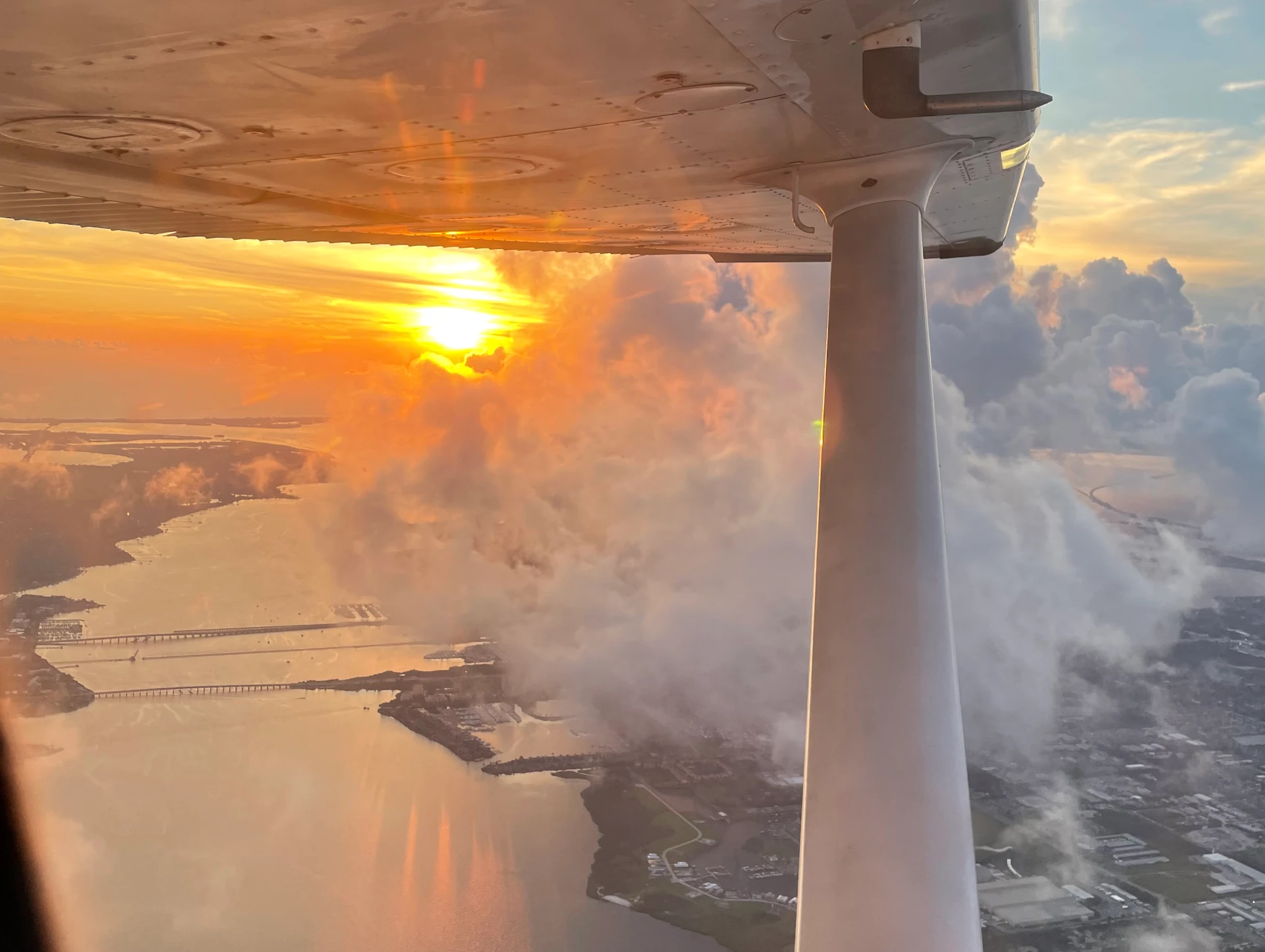
After solo, each flight builds toward cross-country planning and the private pilot practical test.
After solo, your training opens up toward cross-country flying
Your first solo is a turning point, and more solo time follows. The private pilot requirements for a single-engine airplane include at least 10 hours of solo flight time, with solo cross-country flights and three full-stop takeoffs and landings at a towered airport.
Before a solo cross-country, you complete additional ground and flight training, demonstrate cross-country proficiency, and receive more instructor endorsements. Our guide to mastering cross-country flight shows what that next stage looks like for Florida-based students.
Planning your budget for this phase is easier with a clear picture of what remains. If you are weighing how to pay for the rest of your training, explore our flight training financing options, keeping in mind that eligibility and terms come from the provider.
FAQ
Do I need a student pilot certificate for my first lesson?
No. You can take lessons with an instructor before you hold one. You need the certificate before you fly solo, so apply early in your Private Pilot Course.
What medical certificate do I need to solo?
Most first-time airplane students need at least a third-class medical certificate before solo. Our guide to FAA medical classes and BasicMed explains the details.
How many hours does it take to solo?
There is no fixed hour number. Your instructor authorizes solo when you have completed the required training and shown consistent proficiency and safety. Training cadence plays a big role, as our lesson-frequency guide explains.
What is on the pre-solo knowledge test?
The test covers applicable rules in Parts 61 and 91, the airspace and procedures for your solo airport, and your airplane’s flight characteristics and limitations. Your instructor gives it and reviews every missed question with you before you solo, much like the ground work described in our written exam guide.
How long does a solo endorsement last?
The solo endorsement covers the specific make and model and must be updated by an authorized instructor every 90 days to stay current. It is part of the logbook record we keep current as you move through private pilot training.
Can I take a friend flying after I solo?
Not as a student pilot. Student pilots cannot carry passengers. That privilege comes with your private pilot certificate. Our pilot training programs show the path from student to certificated pilot.
Take the first step toward your own solo day
The empty right seat is closer than it feels once you break the milestone into clear, trainable steps: paperwork, knowledge, logged maneuvers, and consistent landings. If you are already training with us, bring this checklist to your next lesson and talk through where you stand with your instructor.
If you are still imagining that moment from the outside, the best way to start is to feel the controls yourself with one of our instructors beside you. Schedule a discovery flight at SRQ and take the first step toward the day you fly solo.