
Towered vs. Non-Towered Airport: Where Should You Learn to Fly in 2026?
Both kinds of airport turn students into pilots. Here is how radio work, pattern practice, and FAA requirements differ, so you can pick the one that fits your goals.
Why Your Home Airport Shapes the Pilot You Become
A towered airport has a control tower. Controllers clear you to take off and land and tell you where to fit in with other traffic. A non-towered airport has no operating tower. Pilots there announce their own position and plans on a shared radio frequency called the CTAF (common traffic advisory frequency).
Pilots at a non-towered field still fly standard traffic patterns and follow FAA operating rules. What changes is who keeps the flow organized: a controller, or the pilots themselves, talking to each other and looking outside.
Students learn to fly well at both, and each one builds certain habits first. Here at Sarasota Bradenton International Airport (SRQ), you train at a towered airport inside Class C airspace, so we see every day how that shapes a new pilot. Our complete guide to learning to fly in Sarasota walks through the rest of the path.
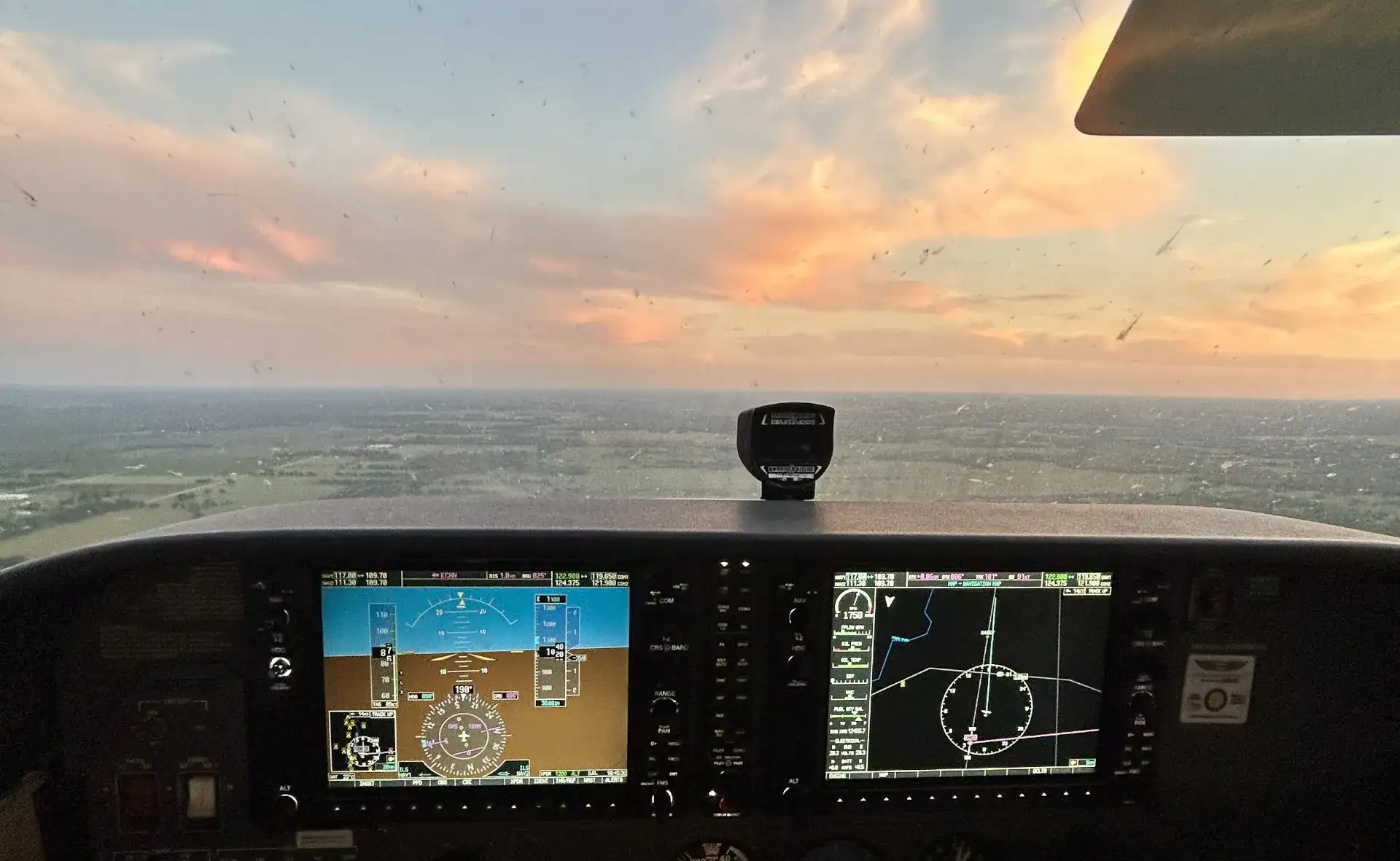
How the Two Airport Types Change Your Training
Each row below is a difference you will feel in the airplane. Neither option comes out safer or better overall; the rows change what you practice most and when you practice it. For a look at where lessons actually go from SRQ, see our Sarasota routes and practice areas.
| What you'll experience | Towered airport | Non-towered airport |
|---|---|---|
| Radio work from early lessons | You talk with the control tower on every flight, and at SRQ with approach control coming home | You self-announce your position and plans on the CTAF |
| Who keeps traffic organized | Air traffic control clears takeoffs and landings and sequences traffic | Pilots coordinate with each other by radio and by looking outside |
| Pattern laps in one lesson | Can be fewer at busy times; the SRQ tower asks for pattern work early in the morning or later in the evening | Often more laps, with less time waiting, at quieter fields |
| Controlled airspace practice | Class C procedures become routine, including radio contact with ATC before you enter | You learn them on trips to a towered airport |
| FAA towered-airport requirement for the private pilot certificate | Met at your home airport | Requires flying to a towered airport |
| Seeing and avoiding traffic | Your job on every flight, with ATC sequencing as a second layer | Your job on every flight, and key because not every airplane has a radio |
| Flight time counts toward your private pilot certificate |
Choose a Towered Airport If You Want Radio and Airspace Confidence Early
Choose a towered airport if talking to air traffic control is the part of flying that worries you most. At SRQ it becomes normal fast, because you hear it on every flight. Your instructor handles the radios until you're ready, then hands them over one call at a time. That repetition removes radio anxiety before your checkride.
It is also the stronger fit if you're aiming for a career in aviation. Busy airports, clearances, and Class C procedures are part of everyday professional flying. Learning them from day one means you are not adding them later. Our first month of flying lessons in Sarasota shows how radio work fits into early lessons.
There's a practical side too. The FAA requires three solo takeoffs and full-stop landings at a towered airport before the private pilot checkride. At SRQ you meet that at home. Expect some waiting at busy times, and plan pattern-heavy lessons for the quieter hours the tower prefers. Learn more about pilot training in Sarasota.

Choose a Non-Towered Airport If You Want More Pattern Time and a Quieter Start
Choose a non-towered airport if your top priority is landing practice. At a quieter field you can often fly more laps in the pattern in one lesson, with less time holding short. That helps if takeoffs and landings are where you want the most repetition.
It also builds self-announcing and traffic-scanning habits. You make your own calls on the CTAF, usually about 10 miles out and when entering the downwind, base, and final legs of the pattern. Because some airplanes have no radio, you learn to keep your eyes outside.
You will still need trips to a towered airport for the FAA's required solo landings and for controlled-airspace practice. Ask any school how they handle that. Our guide to choosing the right flight school lists more questions worth asking.

Towered vs. Non-Towered Training Questions
Is it harder to learn to fly at a towered airport?
It adds radio work early, which can feel like a lot at first. Your instructor handles the radios until you're ready, and the habits you build with a tower work at any airport.
Do I need to train at a towered airport to get my private pilot certificate?
You don't have to be based at one, but the FAA requires three solo takeoffs and full-stop landings at an airport with an operating control tower. Students at SRQ meet that at home. Students at non-towered fields fly to a towered airport to do it.
Is a non-towered airport uncontrolled or unsafe?
No. Pilots at non-towered airports follow standard traffic patterns and announce their position on the CTAF. The safety comes from those procedures and from pilots watching for each other.
What does Class C airspace mean for a student at SRQ?
Before you fly into Class C airspace, you have to be in two-way radio contact with air traffic control, and you stay in contact while you're inside it. More local answers are in our SRQ questions page.
No questions match your search. Try a different word or topic.
Still have questions? Contact our team

Hear the Tower for Yourself
The easiest way to decide is to fly. On a $299 discovery flight from SRQ, you take the controls, listen to the tower, and see how a towered airport feels from the left seat. If cost is part of the decision, we partner with Stratus Financial and Flight Training Finance, so financing can help you keep training.